

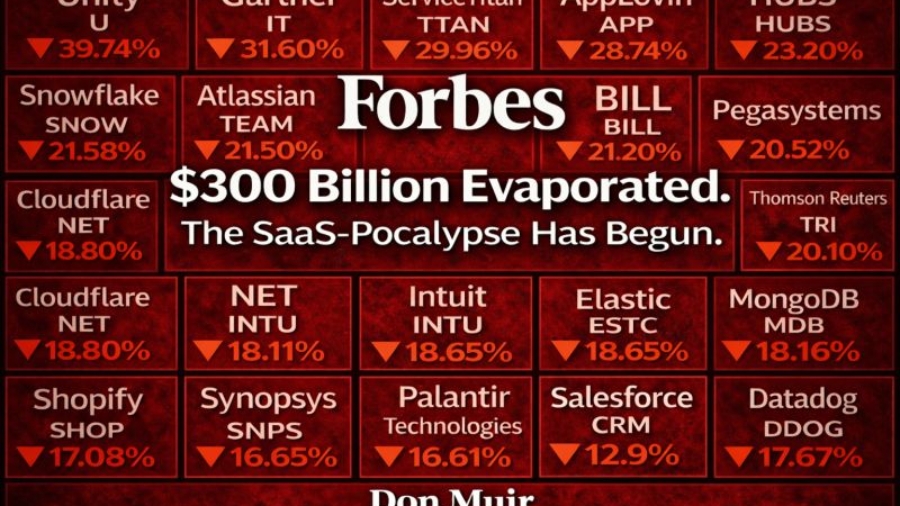
When nearly $300 billion in market value disappeared from software and SaaS stocks in a single day, investors were not reacting to weak earnings or an economic shock. They were responding to something far more disruptive: a major leap in artificial intelligence capability.
Across the sector, established enterprise software leaders such as Salesforce, ServiceNow, Adobe, Workday, and Intuit suffered sharp declines. Several fell by more than seven percent in one session, while Intuit dropped close to eleven percent. At the same time, valuation multiples across listed software companies compressed dramatically, falling from around 39 times forward earnings to nearly 21 times in just a few months.
Short sellers, sensing structural change, have already generated more than $20 billion in profits in 2026 by betting against legacy SaaS providers. And many are increasing those positions.
Markets rarely erase this much value unless a core assumption is being challenged. In this case, that assumption is the long-term durability of traditional SaaS growth.
The Old SaaS Playbook Is Being Rewritten
For more than two decades, enterprise software followed a predictable formula.
Platforms were expensive to build. Switching costs were high. Customer data was locked inside proprietary systems. Once a company adopted a system of record, it tended to stay in place for years, sometimes decades.
This stability made SaaS highly attractive to investors. Recurring revenue was seen as dependable. Contracts were considered sticky. Cash flows were treated as resilient. These beliefs supported premium valuations, leveraged buyouts, and aggressive private credit financing.
AI is now testing every part of that model at once.
What unsettled investors was not that AI can generate better features. Software firms have always competed on functionality. The real shift is that modern AI systems can now execute entire workflows autonomously.
Research, reporting, reconciliation, document drafting, and coordination no longer need to live inside a single application. AI agents can perform these tasks across multiple systems, often without direct human intervention.
In effect, intelligence is becoming mobile. Work is no longer tied to a specific platform.
From Feature Competition to Workflow Substitution
This transition explains why so many established software companies sold off simultaneously.
Feature competition typically reduces margins. But workflow substitution changes spending patterns entirely.
When workflows move, budgets follow.
Enterprises do not need to abandon their legacy systems overnight for this shift to matter. Instead, they consolidate vendors, renegotiate contracts, and reduce seat counts. Usage declines before customers formally leave. Revenue weakens before churn becomes visible.
Markets recognize this dynamic. That is why companies long viewed as “defensive” sold off together, regardless of near-term performance.
Venture capitalist Chamath Palihapitiya captured this mood in a widely shared post, calling it the beginning of a “SaaS meltdown” driven by AI-native workflows.
Investors are now pricing in the risk that large portions of enterprise work will migrate away from traditional applications.
A Growing Market, But a Shifting Profit Pool
Despite the selloff, this is not a story about the collapse of software. It is about the redistribution of value inside a much larger market.
Research from Goldman Sachs suggests that AI agents will significantly expand the overall software market by the end of the decade. However, they are also expected to capture a disproportionate share of industry profits.
By 2030, more than 60 percent of software economics could flow through agent-based systems rather than traditional SaaS licenses.
These agents do not merely enhance applications. They increasingly act as the primary interface to work itself.
As intelligence, memory, and execution shift outside static platforms, legacy economics are diluted. Companies are not necessarily spending less on technology. They are spending less on licenses and more on measurable outcomes.
Revenue is moving from access-based pricing to performance-driven value.
Private Equity and Credit Face New Risks
The implications extend well beyond public markets.
Over the past decade, private equity and private credit firms poured capital into software companies based on predictable cash flows and low churn. These assumptions justified high leverage and flexible covenant structures.
AI does not immediately break these portfolios. Instead, it introduces a dangerous lag.
Spending compression appears before churn. Margins erode before defaults. Reported metrics remain stable even as underlying economics weaken.
For debt investors, this is the most uncomfortable scenario. Risk increases long before financial statements reflect it. By the time problems are visible, pricing power is often gone.
This helps explain why asset managers with heavy exposure to software also traded down during the recent selloff.
Redefining “Recurring” Revenue
At the heart of this shift is a fundamental question: what does recurring revenue mean in an AI-native world?
In the past, replacing enterprise software required long implementations, retraining, and organizational disruption. These barriers reinforced customer loyalty.
AI reduces that friction.
Data is easier to interpret. Intelligence is portable. Workflows are replicable. Switching no longer requires rebuilding entire systems from scratch.
Software increasingly resembles infrastructure. Intelligence becomes the differentiator.
This inversion challenges many of the heuristics investors have relied on for years.
The Rise of Purpose-Built AI Platforms
Some observers argue that enterprises will remain loyal to established vendors and avoid unstable alternatives. To an extent, this is true. Few organizations want to rebuild mission-critical systems from scratch.
But the rental model of SaaS is evolving.
Rather than relying solely on incumbent platforms, forward-looking companies are adopting LLM-agnostic, purpose-built AI systems that deliver portable intelligence and workflow execution. These platforms are not add-ons. They redefine how work is done.
The shift is especially visible in private markets.
In private equity and private credit, the real constraint has never been software availability. It has been human capacity. Highly paid professionals still spend enormous time on manual data processing, documentation, and coordination.
Legacy tools store information. They do not perform the work.
Vertical AI agents win by replacing these offline, labor-intensive processes. They sit between core systems and decision-makers, transforming raw data into actionable output.
The result is not lower software spending, but higher returns on human judgment.
From Interfaces to Execution
From a long-term perspective, the transformation is clear.
Software is not disappearing. But its economic foundations are being rewritten.
Value is shifting toward systems that own execution rather than interfaces. Revenue is becoming less about access and more about impact. Recurrence is giving way to replaceability.
For investors, this creates a difficult reality. Traditional warning signals arrive too late. By the time churn becomes visible, workflow substitution has already occurred.
In an agent-driven economy, competitive advantage belongs to those who understand where intelligence is moving before financial statements reflect it.
That is the disruption markets are now pricing in.
And it is only beginning.