

When venture capital arms start reshaping their thesis, it often signals where industries are truly heading next. For BMW i Ventures, that direction is increasingly clear: artificial intelligence is set to redefine not just mobility, but the entire industrial backbone behind it.
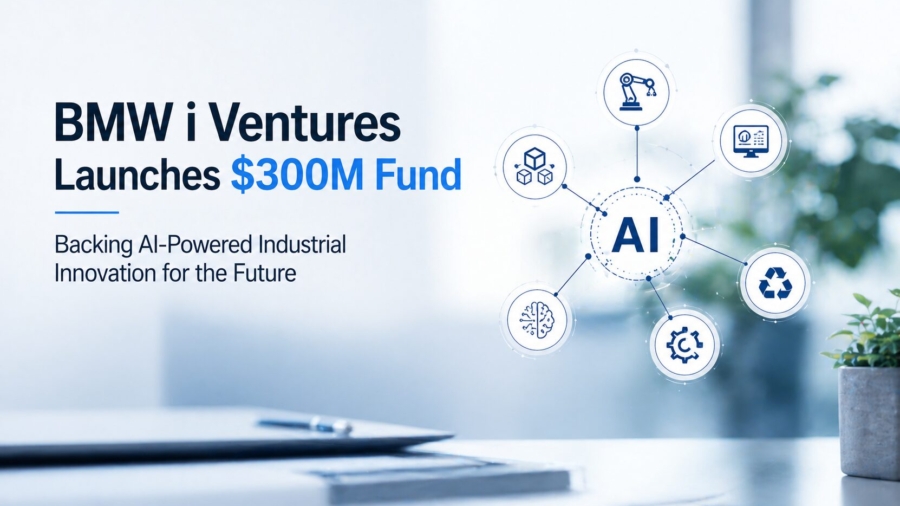
The Silicon Valley-based investment arm of BMW AG has launched a new $300 million fund aimed at early-stage to Series B startups across North America and Europe. The focus goes beyond traditional automotive innovation, targeting emerging categories such as agentic AI, physical AI, industrial software, advanced materials, and next-generation manufacturing and supply chain technologies.
This latest fund brings BMW i Ventures’ total capital under management to approximately $1.1 billion, underscoring its long-term commitment to backing transformative technologies at the intersection of software, hardware, and industrial systems.
From Mobility to Intelligent Infrastructure
The evolution of BMW i Ventures’ investment strategy reflects broader shifts in enterprise technology. Its first fund in 2016 prioritized autonomous driving and digital mobility solutions, while its second fund in 2021 leaned heavily into sustainability and supply chain innovation.
Now, with its third fund, the firm is positioning AI as the foundational layer that will power the next wave of industrial transformation.
According to Marcus Behrendt, the firm’s approach is not about chasing trends, but identifying technologies that will have lasting structural impact.
AI, in this context, is seen less as a standalone innovation and more as an enabling force—one that can reshape how products are designed, how factories operate, and how supply chains are optimized.
The Rise of Agentic and Physical AI
A key area of interest for the fund is agentic AI—systems capable of executing tasks autonomously—as well as physical AI, which applies intelligence to robotics, automation, and real-world environments.
For Kaspar Sage, these technologies represent a shift toward embedding intelligence directly into industrial workflows.
One example highlighted by the firm is Synera, a portfolio company that integrates AI agents into engineering design processes. By combining automation with domain-specific data, Synera enables companies to compress complex design iterations—from weeks of human coordination into minutes of machine-assisted execution.
This kind of efficiency gain illustrates how AI is quietly transforming high-impact but often overlooked processes in industrial environments.
Expanding the AI Toolkit for Sustainability
While AI is taking center stage, BMW i Ventures is not abandoning its previous focus areas. Instead, the firm sees AI as an amplifier for sustainability, particularly in areas like circular supply chains and advanced materials.
Rather than replacing earlier priorities, the new fund expands the toolkit available to startups tackling climate and resource challenges. AI-driven insights, automation, and predictive capabilities can enhance how materials are sourced, reused, and optimized across production cycles.
A Measured Approach to an Overheated Market
Despite the enthusiasm around AI, BMW i Ventures acknowledges the challenge of identifying startups with genuine differentiation in an increasingly crowded space.
The firm has yet to deploy capital from the new fund, signaling a disciplined approach to investment selection. Its previous fund, however, has already backed more than 35 companies, including several AI-focused startups that remain undisclosed.
This cautious strategy reflects a broader reality in today’s venture landscape: while AI dominates headlines, long-term value will depend on real-world applications, not just hype.
Positioning for the Next Industrial Cycle
BMW i Ventures’ latest move highlights a growing convergence between enterprise AI and industrial systems. As software-defined intelligence becomes embedded across physical operations—from design to manufacturing—venture capital is increasingly flowing toward platforms that can bridge digital and real-world environments.
For enterprises, this signals a shift toward more autonomous, data-driven operations. For startups, it represents an opportunity to build foundational technologies that could redefine entire industries.
And for BMW i Ventures, the message is clear: the future of mobility is no longer just about vehicles—it’s about the intelligent systems that power everything around them.