

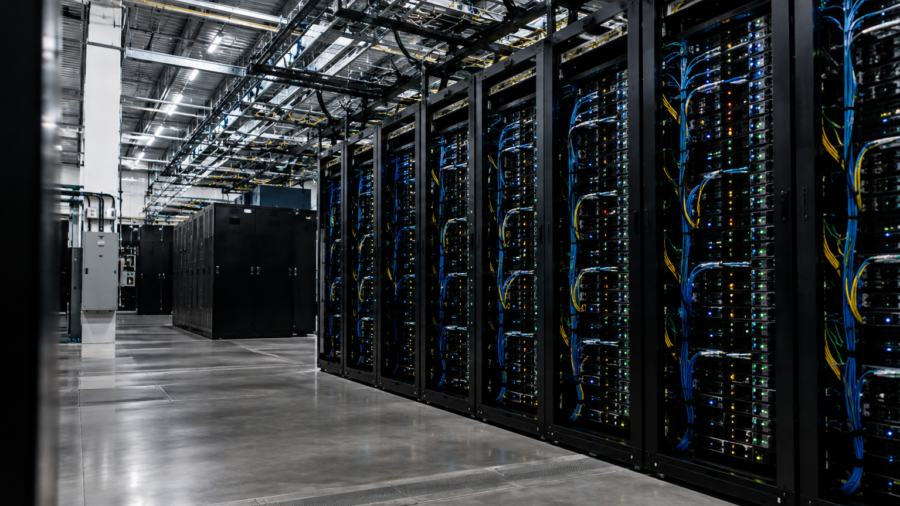
The AI infrastructure race is no longer only about chips, power and computing capacity. It is also becoming a financing challenge as technology companies look for ways to fund data centers that can cost billions of dollars to build.
Companies including Meta, Oracle, xAI and CoreWeave are part of a wider expansion in AI infrastructure that is drawing increased attention to how these projects are financed and where the associated debt ultimately sits. The debate is raising questions about whether the industry is taking on too much financial risk or simply developing new ways to fund an unusually capital-intensive technology buildout.
Why AI Data Centers Require New Financing Models
Building AI infrastructure requires extraordinary amounts of capital.
Modern data centers need land, power connections, cooling systems, networking equipment and increasingly expensive computing hardware. The rapid expansion of generative AI has pushed demand even higher as companies race to secure enough capacity for training and running large models.
One approach involves creating separate entities or special-purpose vehicles that can raise money from banks, private investors and other financial institutions to finance infrastructure projects.
The technology company can then secure long-term access to the completed facility without necessarily carrying all of the project debt directly on its own balance sheet.
That structure is attracting greater scrutiny as the amount of capital involved continues to rise.
More Than $120 Billion Shifted Into Alternative Structures
The scale of the financing is significant.
The Guardian, citing Financial Times reporting, noted that technology companies had shifted more than $120 billion in AI data center spending into special-purpose vehicles and similar structures by late 2025.
Goldman Sachs has estimated that hyperscalers could spend as much as $5.3 trillion on AI and data centers through 2030, with private capital expected to play an increasingly important role in funding that expansion.
At that scale, traditional corporate spending alone may not be enough.
Infrastructure financing could therefore become an increasingly important part of the AI ecosystem, alongside semiconductor supply, electricity generation and data center construction.
Why Some Investors Are Concerned
The use of off-balance-sheet financing has inevitably drawn comparisons with earlier corporate financial failures.
The concern is that investors may underestimate the long-term obligations connected to infrastructure projects if the debt sits outside a technology company’s main balance sheet.
But the current situation is different from previous accounting scandals.
The structures themselves are not automatically evidence of wrongdoing. They can be legitimate tools for sharing the financial burden of infrastructure development among companies, banks and investors willing to take on different levels of risk.
The bigger question is whether future demand for AI computing will be strong enough to justify the enormous amount of infrastructure currently being built.
Data Center Demand Remains Strong
So far, the market continues to show significant demand for capacity.
According to CBRE figures cited by The Guardian, North American data center capacity increased by 36%, yet vacancy still fell to a record 1.4%.
That suggests the industry is not simply constructing empty facilities in anticipation of demand that may never arrive.
Cloud computing, enterprise AI adoption and the expansion of large AI platforms are all creating real pressure on available infrastructure.
Microsoft has also estimated that only 17.8% of the world’s working-age population currently uses generative AI, suggesting that adoption could still have substantial room to expand.
If enterprise and consumer AI usage continues to increase, the demand for computing infrastructure could grow with it.
The Assets Still Have Value
Another important difference between AI infrastructure investment and more speculative technology cycles is the nature of the underlying assets.
Data centers contain land, buildings, electrical systems, networking infrastructure and computing equipment. Even if a particular AI business model underperforms, much of that physical infrastructure can potentially be reused or sold.
That does not eliminate the financial risk.
Some projects may still become unprofitable, lenders could lose money and certain facilities may ultimately be worth less than expected.
But the infrastructure itself does not simply disappear if one company or AI application fails.
That has led some observers to describe the current AI boom as more of an industrial investment cycle than a purely speculative technology bubble.
Private Capital Becomes Part of the AI Stack
For enterprise technology companies, the financing debate highlights something larger.
The AI race is becoming increasingly dependent on industries outside traditional software development.
Semiconductor manufacturers provide the chips. Energy companies provide electricity. Data center operators build and manage facilities. Banks and private investors increasingly provide the capital required to make those projects possible.
Financing is effectively becoming another layer of the AI infrastructure stack.
That shift could become even more important as companies pursue larger data center campuses and increasingly power-intensive AI systems.
What Comes Next
The biggest risk may not be that AI data center financing suddenly collapses, but that infrastructure development gets ahead of demand.
If AI adoption grows more slowly than expected, some projects could struggle to generate the returns investors anticipated.
At the same time, underbuilding carries its own risk. Companies without access to sufficient computing capacity could find themselves unable to compete as AI becomes more deeply integrated into enterprise products and services.
That tension is likely to shape the next phase of the AI infrastructure market.
The technology industry has already entered a period where computing capacity is treated as a strategic resource. Now, the financial structures used to build that capacity are becoming just as important.
As trillions of dollars potentially flow into AI infrastructure over the coming years, the question will not simply be how many data centers the industry can build.
It will be whether the financial models behind them can scale just as quickly.