

Finding an alternative supplier for a critical material involves more than locating another factory. Manufacturers must establish a workable production process, confirm that facilities can deliver consistent quality, and meet demanding specifications. Indian startup Scimplify is targeting that gap between materials research and commercial production, backed by a new $25 million investment.
The Bengaluru-based company raised the funding in an all-equity strategic round led by Hitachi Ventures. Henkel and Teknor Apex, both Scimplify customers, joined as new investors, alongside existing backers Accel India, Bertelsmann India Investments, Omnivore, and 3one4 Capital.
The investment brings Scimplify’s total equity funding to $80 million, according to the company. It comes as the business expands its focus on materials for electronics, semiconductors, defense, and energy, serving manufacturers seeking more diverse supply sources.
Connecting Research With Commercial Production
Founded in 2023, Scimplify combines in-house research with a network of manufacturing partners.
Its teams develop chemical production processes at research facilities in Bengaluru and Hyderabad before transferring them to partner factories for commercial manufacturing. Scientists and engineers oversee the work across a network of more than 500 facilities.
The model addresses a practical challenge in materials development: a promising laboratory result does not automatically translate into a product that can be manufactured reliably at scale. Production methods, equipment compatibility, quality requirements, and regulatory obligations must all be considered.
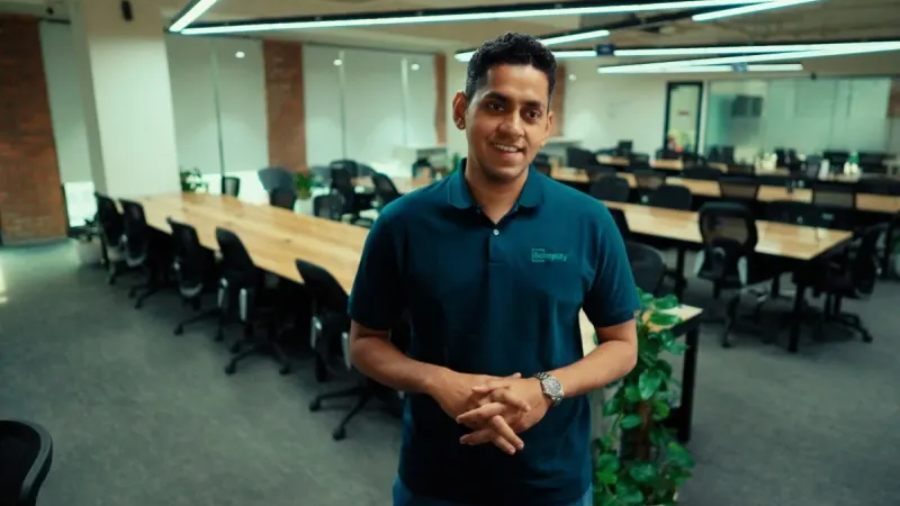
Co-founder Sachin Santhosh told TechCrunch that Scimplify has completed some projects within two months of receiving customer requirements, compared with the 12 to 18 months such work could typically require. He noted that timelines vary by project, making these examples an indication of what the model can achieve rather than a standard delivery promise.
How Scinode Supports the Process
Scimplify’s proprietary AI platform, Scinode, helps coordinate the journey from customer requirements to production.
According to Santhosh, the platform identifies potential manufacturing routes and suitable facilities while tracking quality and regulatory requirements. Specialized AI agents support functions including research, manufacturing, and quality control.
The technology is intended to retain customer context and help teams work through different parts of a project more efficiently. Its role sits alongside the company’s scientists, engineers, and manufacturing partners, whose work remains central to developing and delivering the finished material.
For enterprise customers, the potential value is better coordination across a process that often involves separate research teams, factories, and quality systems.
Expanding Beyond India
Approximately 90% of Scimplify’s manufacturing currently takes place in India. Santhosh said the company plans to expand its production network into the United States and Japan over the next year.
The U.S. has already become a significant growth market. Its annualized revenue run rate there has risen to approximately $60 million, from $10 million a year earlier, according to Santhosh.
He said the U.S. now represents roughly 30% of the business, while customers outside India collectively account for more than half of revenue. Around 18 months earlier, international customers contributed less than 5%.
Scimplify plans to allocate approximately $7.5 million from the latest round to its U.S. expansion, including developing its manufacturing network. That allocation remains subject to change. Another $2 million has been earmarked for further development of Scinode.
Growing Demand for Critical Materials
Energy, electronics, and defense now generate approximately 45% to 50% of Scimplify’s revenue, up from less than 15% a year ago, Santhosh told TechCrunch.
The company is developing tungsten derivatives using scrap as a feedstock and is also working on rare-earth materials. Both areas reflect its efforts to create alternative sources for materials with geographically concentrated supply chains.
Its customers include TDK, BASF, and Hitachi. The participation of Henkel and Teknor Apex in the funding round also brings existing commercial relationships into its investor base.
These connections matter because materials businesses must demonstrate more than technical feasibility. Buyers need confidence that a supplier can deliver products meeting their specifications consistently and at commercial volumes.
Revenue Momentum and Financial Targets
Scimplify reports serving more than 1,000 customers and delivering products to over 40 countries.
Santhosh said the company has reached an annualized revenue run rate of approximately $200 million, three times its level a year earlier, and is targeting $400 million over the next year.
An annualized run rate projects revenue at the current pace of business; it is distinct from revenue recorded over a completed financial year.
Santhosh also said Scimplify had been EBITDA-positive for the preceding two months and expected to become profitable after tax in October. That profitability expectation remains a forward-looking statement.
TechCrunch reported a post-investment valuation of $250 million, citing a person familiar with the transaction. Scimplify declined to disclose its valuation.
The Enterprise Opportunity
Scimplify’s business combines AI-assisted coordination with the physical work of materials development and manufacturing. Its opportunity lies in helping customers establish additional supply options while shortening the path from a specification to a commercially usable product.
The new funding gives it resources to expand that model internationally. Its next test will be maintaining quality, delivery consistency, and financial performance as more projects move through a broader manufacturing network.
For enterprise buyers, those operating results will determine how useful Scimplify becomes as an alternative source of specialty chemicals and critical materials.
Source: The TechCrunch report supplied, published October 14, 2026. Additional coverage corroborates the funding and strategic investor participation. Company Business News