

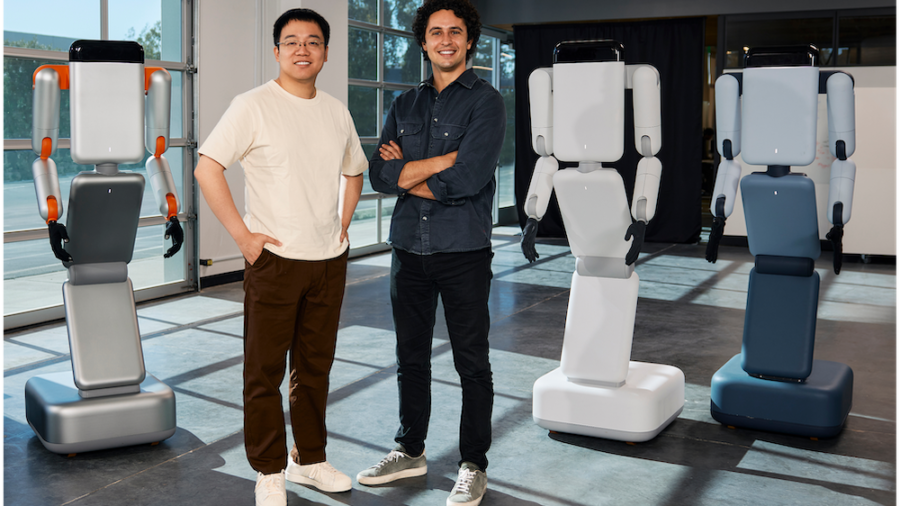
Robotics startup Genesis AI has raised US$500 million in Series A funding as it accelerates the development and deployment of robots capable of performing complex physical tasks. The round was co-led by Khosla Ventures, Premji Invest and Eclipse, valuing the company at US$3.5 billion. The funding marks a major step for the startup as it works to move advanced robotics beyond demonstrations and into everyday business operations.
Founded in 2024 by Zhou Xian and Théophile Gervet, Genesis AI is developing general-purpose robots designed to learn and carry out physical work. Rather than focusing only on robot hardware or artificial intelligence software, the company is building its own robotics models, training systems, data collection technology and machines. This integrated approach is intended to help its robots learn faster and perform tasks more reliably in real-world environments.
Teaching Robots to Work Like Humans
One of the company’s main areas of focus is dexterity, particularly the ability of robots to use their hands to handle objects and complete detailed tasks. While robots can already perform repetitive industrial operations, more complicated activities involving touch, movement and coordination remain difficult to automate.
Genesis AI demonstrated its technology using robotic arms that completed a series of packaging tasks. The machines picked up cardboard boxes, scanned them, placed them inside a larger box, folded the packaging, applied tape and attached a shipping label. Although the demonstration showed promising capabilities, the robot also struggled with some movements, highlighting the challenges that remain before these systems can operate consistently without assistance.
To improve performance, Genesis collects real-world movement and touch data using specially designed sensor-equipped gloves. More than 100 workers around the world wear these gloves alongside camera-equipped headsets while carrying out physical activities. The information gathered helps train the company’s AI models to understand how people interact with objects and perform everyday tasks.
The company’s robotic hands are designed to closely match the proportions of human hands, allowing the machines to learn movements that require greater precision. Genesis believes this combination of human-generated training data and specialised hardware can help its robots handle tasks that traditional industrial machines struggle with.
Building Its Own AI Models and Robots
At the centre of Genesis AI’s technology is GENE, its robotics foundation model, designed to help machines understand and perform physical activities. The company also invests heavily in simulation, using virtual environments to generate millions of detailed training scenarios before applying those skills to physical robots.
Its approach brings together AI development, data collection, simulation and hardware engineering. By controlling these parts of the process, Genesis aims to create a continuous improvement cycle in which information from real-world robot operations can be used to strengthen its models and improve future machines.
The company has also introduced Eno, its first flagship robot. Built with a wheeled base, two arms and highly dexterous hands, Eno is designed to perform physical work without relying on the traditional humanoid appearance of exposed mechanical structures. Genesis has reportedly built between 30 and 40 units and is already piloting the machine with a small number of undisclosed customers.
Major Investors Back the Company’s Expansion
The US$500 million funding round includes participation from several major investment firms and technology companies. Alongside the three co-leads, investors include NVIDIA, AMD Ventures, Samsung Next, Ericsson, Bpifrance, HSG, Durable Capital Partners and accounts advised by T. Rowe Price.
The round also attracted prominent individual investors, including former Google CEO Eric Schmidt, Zoom CEO Eric Yuan, former Yahoo CEO Jerry Yang, French technology entrepreneur Xavier Niel and former Tesla CFO Zach Kirkhorn.
The investment will help Genesis move towards larger-scale production and real-world deployments. The company has selected a manufacturing partner to begin work in the United States next year, with the design of its mass-produced robot already finalised. Its initial focus will be on industrial customers in manufacturing, logistics and laboratories, before potentially expanding into hospitality, healthcare and other sectors.
The Challenge of Scaling Real-World Robotics
Despite its progress, Genesis AI still faces important engineering challenges. The company has acknowledged that its robotic hands currently need replacement after a few weeks of regular operation, highlighting the durability requirements involved in deploying machines in demanding work environments.
Moving from impressive demonstrations to reliable commercial use will also require improvements in hardware, manufacturing and the availability of high-quality training data. Businesses need robots that can complete tasks consistently over long periods, rather than machines that perform well only under controlled conditions.
With its latest funding and a reported US$3.5 billion valuation, Genesis AI is positioning itself among the companies competing to shape the next generation of robotics. Its ambition is to develop general-purpose machines capable of learning a wide range of physical tasks, starting with industrial applications and eventually reaching more areas of everyday work.
The next stage will be proving that its technology can deliver reliable performance at customer sites and scale beyond controlled demonstrations.