

Asset and auto finance may be established parts of financial services, but the technology behind them is changing quickly. Lenders are under pressure to modernize legacy systems while introducing more automation, better digital experiences and AI into operations that can be difficult to replace or redesign.
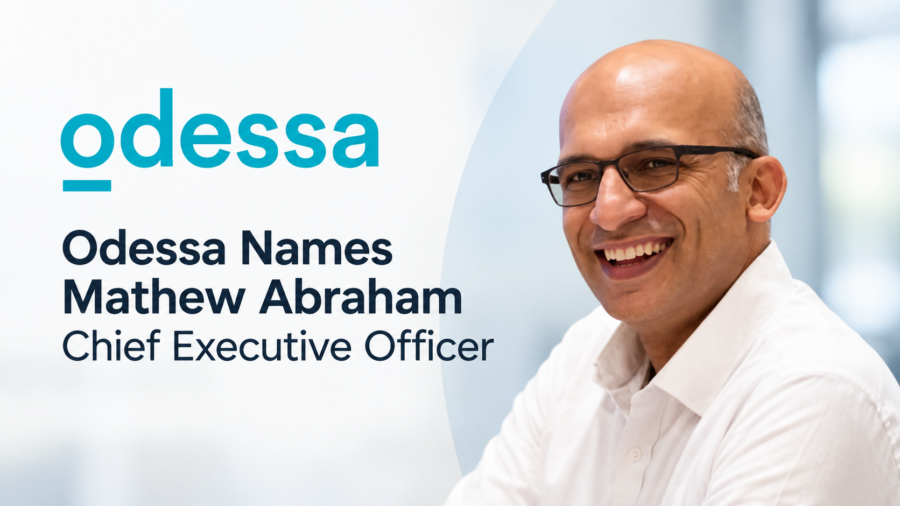
Odessa is entering the next phase of that transition with a familiar executive at the helm. The asset and auto finance software company has appointed Mathew Abraham as Chief Executive Officer, effective September 21, 2026. He succeeds Joe Juliano.
Abraham previously served as Odessa’s Chief Operating Officer from 2019 to 2022, where he led its global delivery organization across implementation and customer success. His return puts an executive who already understands the company and its customers in charge as Odessa expands across markets, geographies and products.
Returning to Odessa at a Different Stage of Growth
Since Abraham’s previous tenure, Odessa has continued to broaden the technology sitting behind its asset finance platform.
Over the past 18 months, the company says it has completed more than 20 implementations across North America, Europe and APAC. Odessa currently serves clients in 55 countries and provides technology covering the asset finance lifecycle from origination and servicing through remarketing.
Abraham returns after most recently leading and scaling a global business at Veeco. Earlier in his career, he held senior leadership positions at ASML, Applied Materials and Intel, giving him experience across large technology and semiconductor organizations. He also holds a PhD from Harvard University.
That combination of operational and technology experience is relevant to where Odessa is heading. Executive Chairman Madhu Natarajan pointed to Abraham’s previous knowledge of Odessa alongside his industry and operational experience as important to the company’s next stage.
AI Moves Deeper Into the Asset Finance Platform
The leadership change comes as Odessa increases its investment in AI and automation rather than treating them as standalone additions to its software.
The company is developing AI capabilities across generative, predictive and agentic systems. Its roadmap includes document intelligence, predictive customer and portfolio signals, digital assistants and workflow agents designed to automate repeatable operational work within defined controls.
Odessa has also been expanding its auto finance technology. In March, the company detailed new investments in intelligent automation and predictive analytics, alongside integrations with ABBYY for document processing and TruDecision for AI-driven decisioning and credit capabilities.
The focus goes beyond AI alone. In July, Odessa introduced Configurable Attributes, allowing asset finance organizations to extend data models, APIs, reporting and business rules without custom code or direct vendor involvement. The capability is intended to give banks, captive finance companies and independent lenders more control as they introduce new products, enter markets or respond to regulatory requirements.
Together, these developments show why the CEO transition matters beyond the leadership change itself. Abraham is returning to a company increasingly focused on making a traditionally complex part of financial services more configurable, automated and intelligent.
Leading the Next Phase of Asset Finance Modernization
Asset finance platforms often sit at the center of long-running financial operations, which makes modernization more complicated than simply replacing one application with another.
Odessa’s platform is built around origination, servicing and remarketing, with API connectivity and automation intended to help lenders connect systems and reduce manual processes. The company says it also reinvests 27% of total payroll into ongoing research and development.
For Abraham, the immediate challenge will be translating those investments into broader adoption while maintaining the reliability expected by banks, captive finance businesses and independent lessors.
He described asset and auto finance as entering a period increasingly shaped by automation, AI and more sophisticated digital experiences. His return gives Odessa a CEO who has already managed its implementation and customer-success operations, but who now takes responsibility for the entire business as those technologies become more central to its platform.
Odessa already has the global footprint and industry specialization behind its strategy. Abraham’s next task is to turn the company’s recent investments in AI, automation and platform flexibility into the next stage of growth across the markets it serves.