

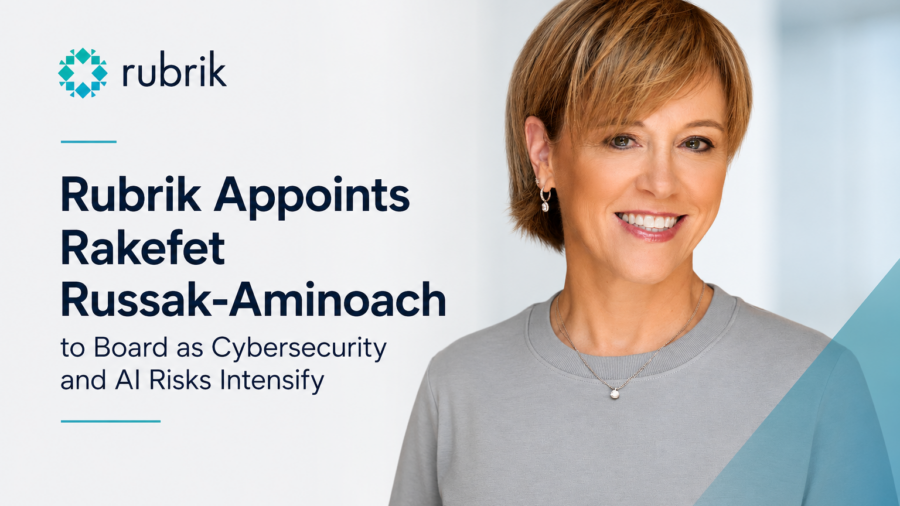
As cybersecurity becomes an increasingly important board-level issue, Rubrik is adding deeper financial services and digital transformation experience to its leadership.
The U.S. data security company has appointed Rakefet Russak-Aminoach, former CEO of Bank Leumi and currently a Managing Partner at Team8, to its board of directors.
The appointment brings an executive with extensive experience across banking, fintech and enterprise technology into Rubrik’s boardroom at a time when organizations are facing growing pressure to protect critical data and adopt artificial intelligence securely.
Bringing Financial Services Experience to Rubrik
Russak-Aminoach spent several years at the helm of Bank Leumi, one of Israel’s largest financial institutions, where she led the organization through a period of significant technological change.
Her experience extends beyond traditional banking. She founded LeumiTech, the bank’s technology-focused banking platform, as well as digital banking initiative Pepper, giving her direct experience building new financial services around emerging technologies.
Today, Russak-Aminoach is a Managing Partner at Team8, where her work focuses on building and investing in fintech and enterprise infrastructure companies.
She also serves on the board of BNY, bringing another connection to the global financial services industry.
That combination of financial leadership and technology experience could be particularly relevant for Rubrik as cybersecurity becomes more closely connected with broader business resilience.
Cybersecurity Becomes a Financial Leadership Issue
Financial institutions remain attractive targets for cybercriminals because of the sensitive information, financial assets and critical systems they manage.
At the same time, banks and other regulated organizations are adopting cloud services and AI technologies that can create new security and governance challenges.
For Rubrik, adding an executive who has managed a major financial institution provides additional perspective on how large organizations approach those risks.
Bipul Sinha, CEO, Chairman and Co-founder of Rubrik, highlighted Russak-Aminoach’s experience operating within complex regulatory environments and leading digital transformation across financial systems.
Her background could help Rubrik better understand the security priorities of financial institutions as the company expands its position in enterprise data security.
Rubrik Expands Around Data Security and AI
Rubrik has built its business around protecting enterprise data and helping organizations recover from cyber incidents.
The company has increasingly positioned its technology around cyber resilience, particularly as ransomware and other attacks make traditional prevention strategies alone insufficient.
Artificial intelligence is adding another dimension to that challenge.
Enterprises want to use AI across more parts of their operations, but doing so can increase the importance of controlling access to sensitive corporate data and understanding where that information is stored and used.
Russak-Aminoach described cybersecurity and the secure adoption of AI as increasingly important to organizational stability, pointing to Rubrik’s position in both areas.
An International Technology Footprint
Rubrik also maintains a significant connection to Israel’s cybersecurity ecosystem.
The company established a development operation in the country following its 2023 acquisition of cloud data security startup Laminar.
That acquisition expanded Rubrik’s capabilities while giving the company access to Israel’s deep cybersecurity engineering talent.
Rubrik has since continued expanding as a publicly traded cybersecurity company. Its growth reflects broader enterprise demand for technologies capable of protecting increasingly distributed data across cloud and on-premises environments.
Joining an Experienced Technology Board
Russak-Aminoach joins a board that already includes executives and investors with significant experience across the technology industry.
Among them is John W. Thompson, the former chairman of Microsoft who previously led the search process that resulted in Satya Nadella becoming Microsoft CEO.
Other board members include Ravi Mhatre, co-founder and Managing Director of Lightspeed Venture Partners, and Mark McLaughlin, former Chairman and CEO of Palo Alto Networks and a longtime technology executive.
Russak-Aminoach adds a different dimension to that mix through her experience running a major bank and developing financial technology businesses.
Connecting Cybersecurity With Business Resilience
The appointment illustrates how cybersecurity leadership is expanding beyond purely technical expertise.
For companies serving large enterprises, understanding regulation, financial infrastructure and executive decision-making can be just as important as understanding the underlying security technology.
This is particularly relevant as AI introduces new questions around data access, governance and security.
Financial institutions must balance the potential productivity and customer benefits of AI against strict requirements around privacy, security and regulatory compliance.
Russak-Aminoach has worked on both sides of that equation, first as the leader of a major financial institution and now as an investor helping build fintech and enterprise technology companies.
What the Appointment Means for Rubrik
For Rubrik, the appointment adds financial-sector expertise at a point when cyber resilience is becoming increasingly tied to broader enterprise risk management.
The company is selling into organizations that need to protect not only their data but also the continuity of their operations following an attack.
Russak-Aminoach’s experience managing regulated financial infrastructure and leading digital transformation could provide valuable perspective as Rubrik develops its strategy for those customers.
Her appointment also highlights a wider shift taking place across enterprise technology: cybersecurity and AI governance are increasingly becoming issues for the entire leadership team and board, rather than responsibilities confined to IT departments.
As businesses put more critical data behind AI-driven systems and digital services, that connection between technology, security and corporate governance is likely to become even more important.