

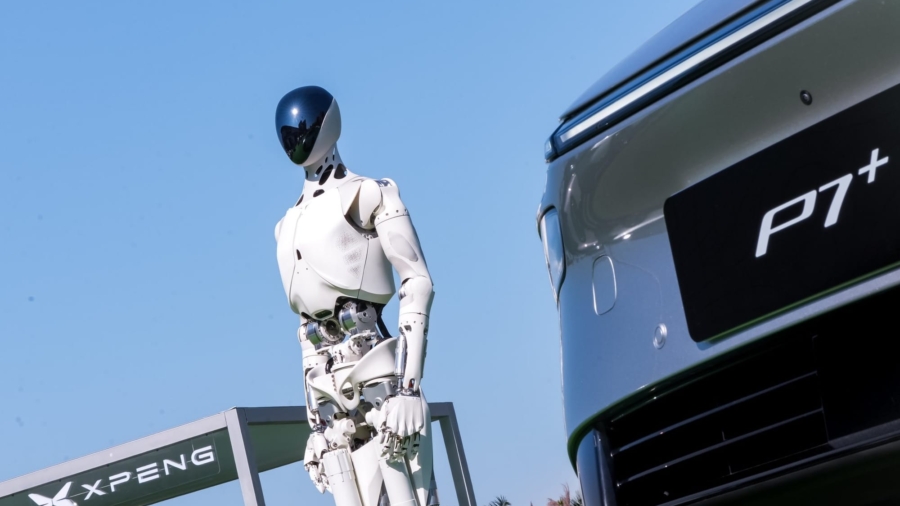
Humanoid robotics is moving closer to commercial scale, and XPeng is putting serious capital behind that transition.
The Chinese automaker’s robotics unit has raised more than $900 million in its first external funding round, valuing the business at over $6.3 billion. The round was led by IDG Capital, with participation from Tencent, Alibaba, Gaorong Ventures and other investors.
The funding gives XPeng more room to accelerate development of its IRON humanoid robot while building the manufacturing capacity needed to move beyond prototypes and small-scale deployments.
From Robotics Development to Production
XPeng plans to use the new capital across both hardware and software development.
The company is investing in physical AI models, robotics data collection and the manufacturing infrastructure required to produce humanoid robots at greater scale.
Its near-term target is ambitious. XPeng plans to reach production of around 1,000 IRON humanoid robots per month by the end of 2026.
That would move the company closer to one of the biggest challenges facing humanoid robotics today: turning technically impressive machines into products that can actually be produced and deployed consistently.
Early Use Cases in Retail and Industry
XPeng expects the first wave of IRON deployments to focus on retail and industrial environments.
These are areas where humanoid robots could perform repetitive, structured or physically demanding tasks while companies test how the technology behaves outside controlled demonstrations.
Broader commercial sales are expected to follow in 2027.
That timeline suggests XPeng is trying to build a path from experimentation to practical use rather than treating humanoid robotics as a long-term research project.
He Xiaopeng Takes Direct Control
XPeng CEO He Xiaopeng will personally lead the robotics division as the company increases its investment in embodied AI.
The move puts robotics closer to the center of XPeng’s broader technology strategy.
The company sees a natural connection between humanoid robots and intelligent vehicles. Both rely on areas such as perception, autonomous decision-making, AI models, sensors and real-world interaction.
That overlap could allow XPeng to reuse parts of the technology, engineering knowledge and data infrastructure it has already developed through its automotive business.
Tencent and Alibaba Back the Expansion
The presence of Tencent and Alibaba in the round adds another layer to the story.
Both companies have significant AI and technology ecosystems, and their participation brings additional attention to an increasingly competitive robotics market in China.
The investment also shows how humanoid robotics is attracting capital from companies that already have major positions in cloud computing, AI and digital platforms.
For XPeng, those relationships could become useful as the robotics business grows beyond hardware and increasingly depends on software, AI infrastructure and large-scale data.
A Growing Race Around Embodied AI
Humanoid robotics has become one of the most competitive areas of emerging technology.
Companies are betting that improvements in AI models, sensors and robotics hardware could make machines more capable of navigating unpredictable real-world environments.
But progress in AI does not automatically solve the manufacturing challenge.
Humanoid robots still need to become more reliable, easier to maintain and cheap enough for companies to justify deploying them at scale.
That makes XPeng’s production target significant. Reaching 1,000 units a month would represent a shift toward treating humanoid robots more like commercial hardware products rather than experimental machines.
Why This Funding Matters
The more than $900 million round is also notable because it represents one of the largest investments yet in China’s embodied AI sector.
The capital will allow XPeng to expand production lines while continuing to improve the software and AI systems behind IRON.
It also gives the company more time to identify which use cases can generate meaningful demand.
Retail and industrial environments provide a logical starting point because tasks can often be defined more clearly than in homes or other highly unpredictable settings.
The Next Test for Humanoid Robotics
The biggest question now is not whether companies can build impressive humanoid robots.
The harder challenge is proving that they can manufacture them reliably, deploy them at scale and deliver enough value to justify their cost.
XPeng is betting that the combination of its automotive engineering experience, AI capabilities and new funding can help close that gap.
With production expected to accelerate through the end of 2026, IRON could become an important test of whether humanoid robotics is ready to move from demonstrations into everyday commercial environments.